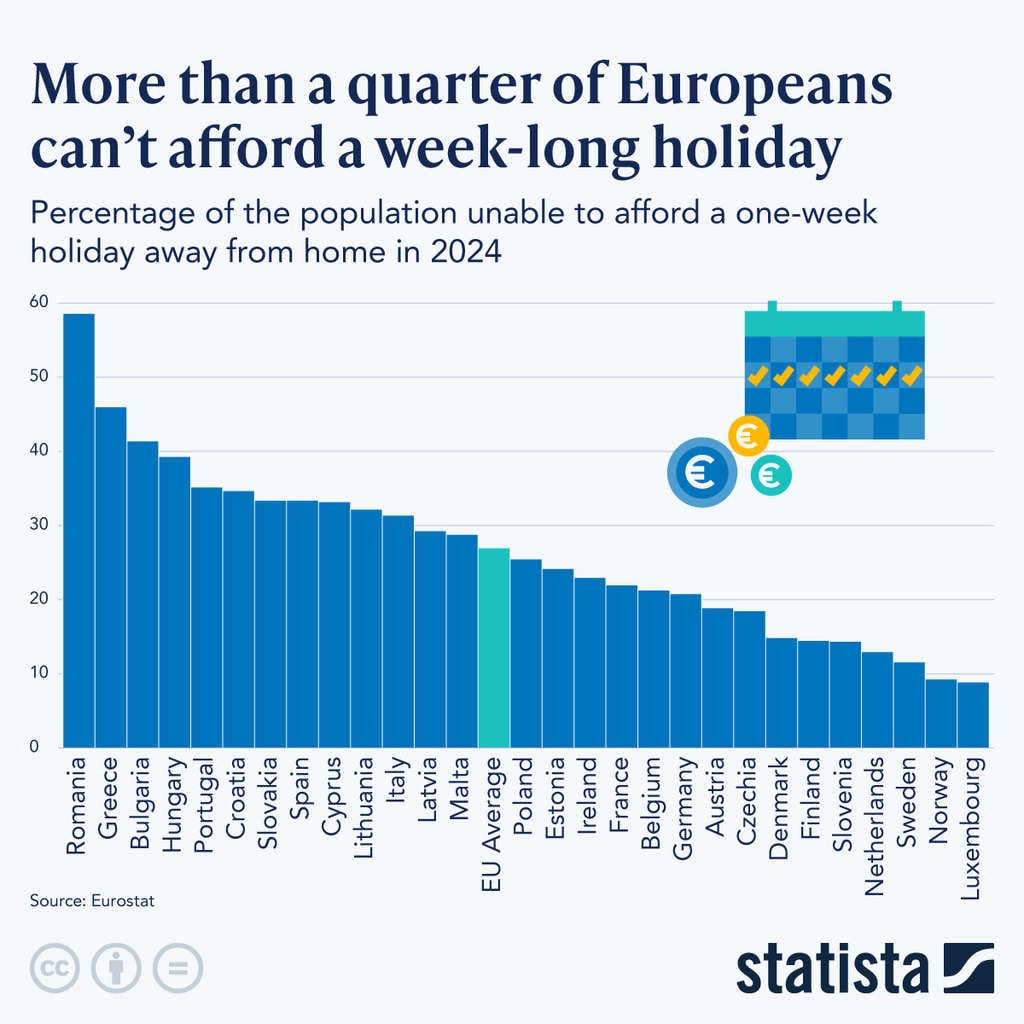
What does it take for a family to afford a week away? Today, Eurostat estimates that for more than one in four Europeans the answer is that they can’t. Rising prices and tighter household budgets mean that millions are being priced out of the chance to travel — even though travel has never mattered more for connection, culture, and moments of rest and renewal.
That’s why transparency, choice, and razor sharp focus on the customer aren’t abstract concepts to us at Booking.com. They are the principles that guide how we build and innovate, and the ones that help travelers make every euro count. And research by Oxford Economics shows that online travel platforms like ours deliver: lowering prices, expanding choice, and giving people the clarity they need to book with confidence.
Travel is a powerful force for human connection, cultural understanding, and local vitality — especially in destinations where tourism supports jobs and community prosperity. In a time when many households are watching their budgets closely, well-structured information and fair prices give travelers the confidence they need to make informed booking decisions.
Affordable travel through competition and choice
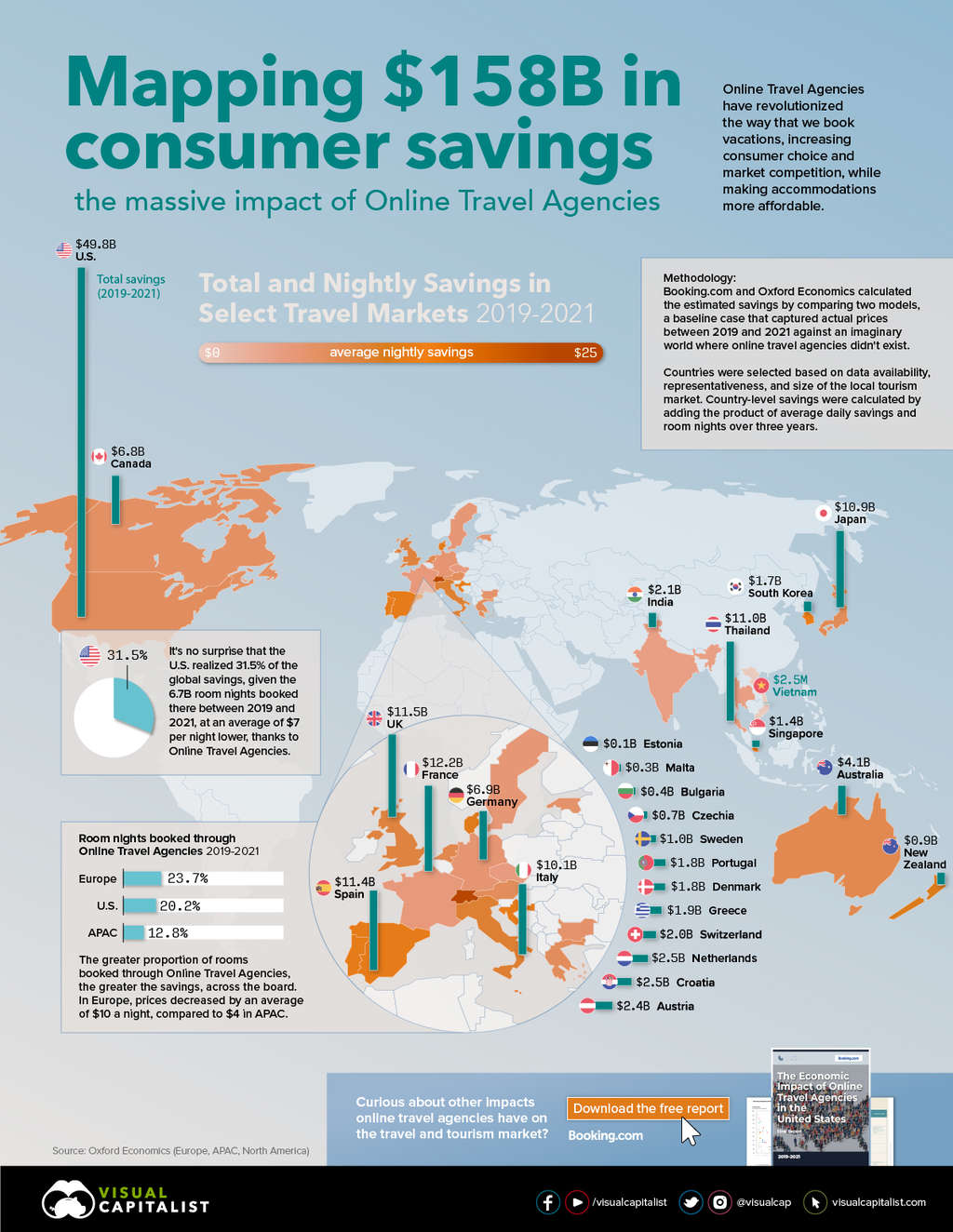
When competition works, travelers benefit. A global study by Oxford Economics examined hotel prices between 2019 and 2021 and modeled what the world would look like without online travel agencies. The results were clear:
- Travelers saved $158 billion worldwide in just three years and that’s just in the markets covered by the research.
- In Europe alone, consumers kept $69.4 billion in their pockets.
- Prices fell by nearly $10 per night on average in Europe due to the presence of OTAs .
- Markets with more OTA usage saw the greatest consumer savings.
These aren’t abstract figures — they represent real families able to afford a vacation, young people able to take their first trip abroad, and countless travelers finding better options at the right price.
Transparency travelers rely on
Useful information is one of the most effective tools consumers have and comparison is one of the most reliable ways to decide what offers the best value. New research, by Statista, shows that travelers value Booking.com for helping them evaluate alternatives and choose the option that best meets their needs.
According to a 2025 Statista survey of 8,000 EU users:
- 84% say ranking and filters help them easily compare options.
- 83% view Booking.com as a trustworthy platform valued for its transparency.
- 82% find cancellation and payment terms easy to understand.
- 81% say prices are trustworthy, with no surprises at checkout.
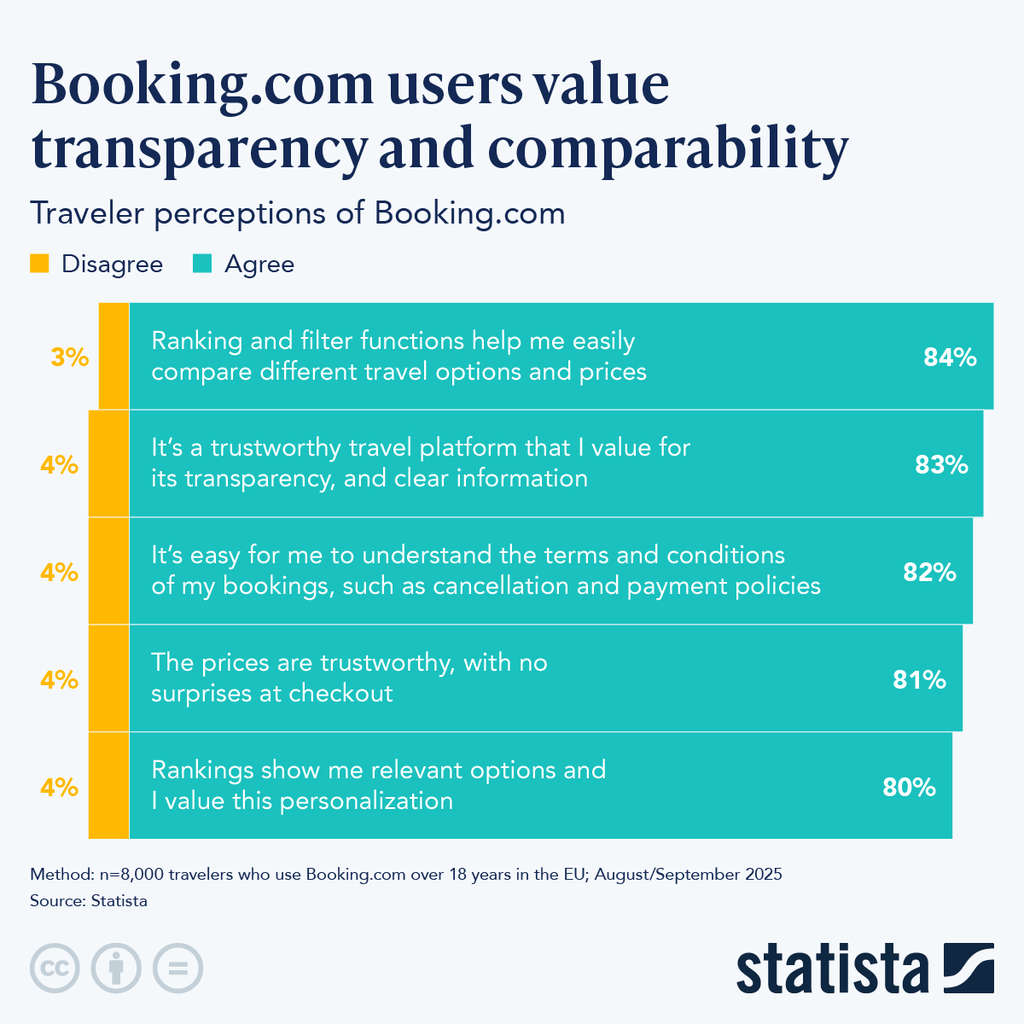
These findings reflect years of investment in price integrity, full-cost display, and user-friendly tools that support confident and informed decision-making.
Trusted, authentic reviews are another pillar of consumer confidence. Millions of verified reviews on Booking.com help travelers understand what to expect, compare quality across properties, and feel assured that their choice reflects real experiences. Earlier this year, we endorsed the EU’s new Code of Conduct for Online Ratings and Reviews — a major step forward in strengthening trust in digital marketplaces.
Why affordability matters
Over the past generation, rising incomes, more efficient transportation, and digital access have turned travel from a luxury enjoyed by a few into something readily attainable for modern middle classes. Yet despite this progress, affordability challenges persist. Eurostat (2024) reports that more than one in four Europeans cannot afford a one-week holiday, and in some Member States that share is closer to half of the population.
In this environment, the consumer savings and transparency created by digital platforms are not simply conveniences — they help ensure travel remains accessible. Online platforms broaden choice and reduce information asymmetry between consumers and service providers that can lead to higher prices.
Supporting a fair, competitive travel market
Booking.com connects millions of travelers with hundreds of thousands of accommodations worldwide — from family-run guesthouses to international hotel chains — helping ensure that properties of every size can compete on visibility, quality, and value. Independent hotels, which often fall in the category of small and medium-sized enterprises (SMEs), make up over 70% of Europe’s accommodation market, and a level playing field helps them thrive. When SMEs can reach customers globally, it strengthens local economies, diversifies supply, and increases competitive pressure — outcomes that benefit travelers through better prices and more meaningful choice.
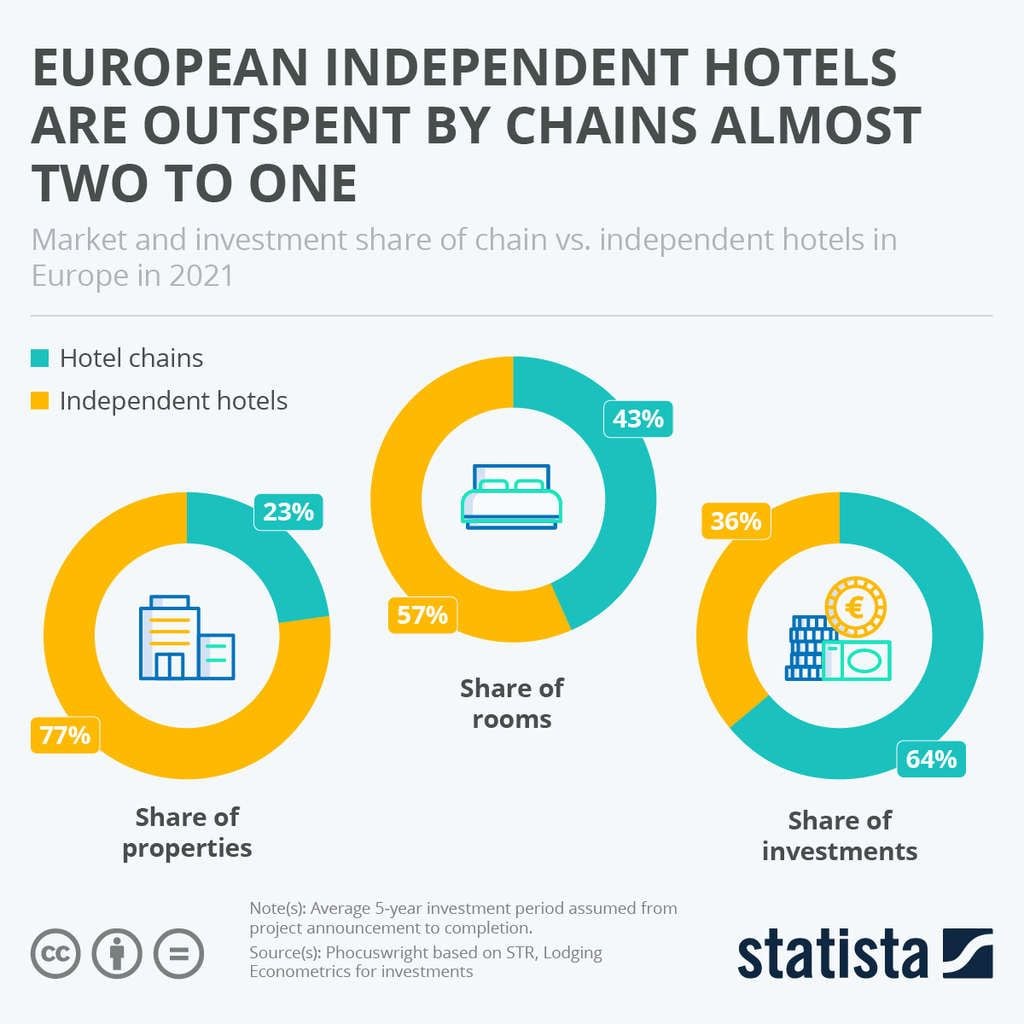
By making prices, room types, amenities, and terms easily comparable, our platform turns competition into something consumers can actually see. This drives fairer prices, better service, and a more dynamic travel sector.
At the same time, we continuously review and improve our design and disclosures. Our goal is consistent: to provide clarity, fairness, and choice at every step.
Competitive and transparent prices for travelers
In this context, we are aware that two Dutch consumer organizations — the Consumers’ Association (Consumentenbond) and the Consumer Competition Claims Foundation (CCC) — supported by third-party litigation funders, have launched a collective action in the Netherlands.
We take their concerns seriously, but we do not agree with the claims presented. We have always been committed to showing travelers the best possible prices and the best user experience and reject any claims to the contrary. Service providers set their own prices on Booking.com, and our role is to present those prices clearly and consistently so travelers can compare their options.
Transparency, price integrity, and consumer trust are core to how Booking.com operates. Our platform is designed to help travelers make informed decisions — which is why we provide full-cost display, straightforward cancellation terms, and easy-to-use comparison tools.
Research shows that consumers recognize these efforts: according to a 2025 Statista survey of 8,000 EU travelers, 83% consider Booking.com a trustworthy platform that they value for its transparency and useful information, and 81% say prices on our platform are trustworthy, with no surprises at checkout.
Some of the issues raised in the Dutch claim relate to parity clauses historically used across the accommodations industry. As we have explained previously, these clauses were removed across Europe as part of our compliance with the EU Digital Markets Act. While once common practice in many sectors seeking to ensure consistent and transparent pricing for consumers, we have adapted our agreements to reflect evolving regulatory expectations.
As with any public claim, the existence of allegations does not determine their accuracy. We remain fully committed to cooperating with relevant authorities, engaging constructively with consumer organizations, and continuing to deliver the transparency, choice, and affordability that millions of travelers rely on every day.
View source