Food
Pizza Hut Classic is fast becoming a cultural obsession. I spent a day at one to find out why.
By
Luke Winkie
Enter your email to receive alerts for this author.
Sign in or create an account to better manage your email preferences.
Sign up for the Slatest to get the most insightful analysis, criticism, and advice out there, delivered to your inbox daily.
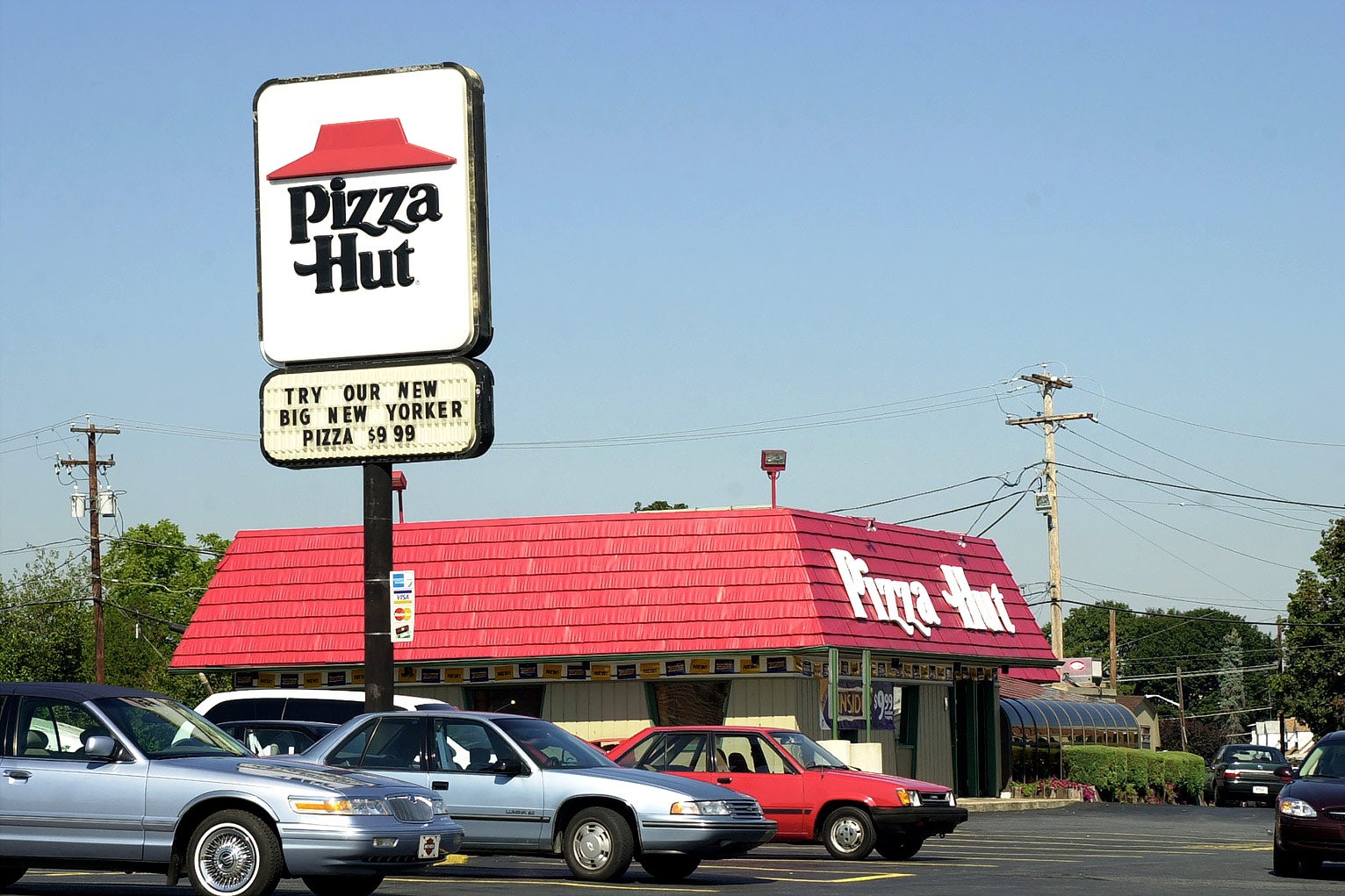
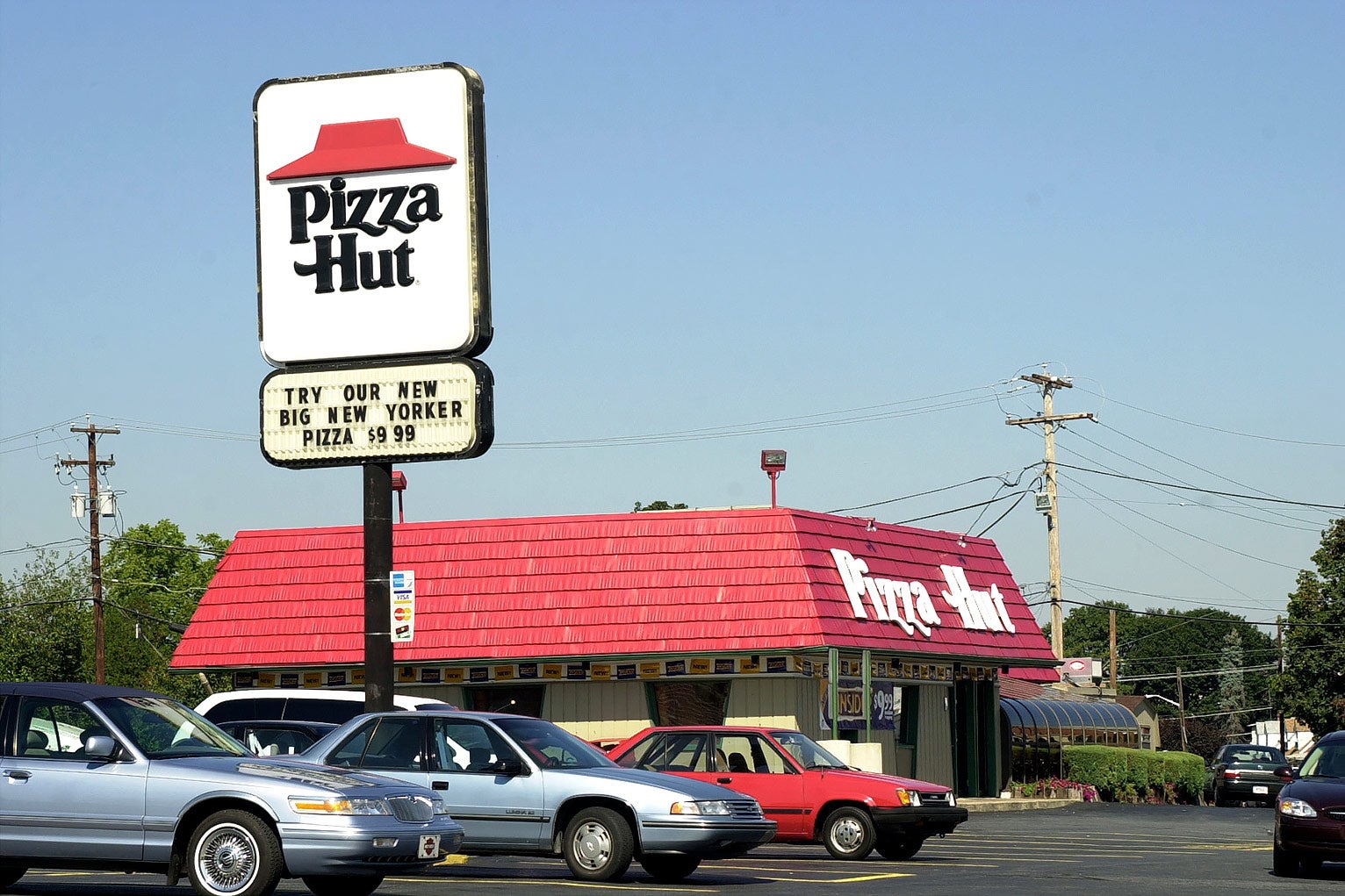
If you think I am crazy for renting a car and driving three hours out of New York—through the Holland Tunnel, onto the New Jersey Turnpike, and across the Susquehanna River—just to eat at a Pizza Hut, know that I’m far from the only person who has made the trip. There are more than 6,000 Pizza Huts dotting the thoroughfares of the United States, and almost all of them look exactly the same: The interiors are squat, bland, and cramped; the dining options are restricted to takeout and delivery; there is no soundtrack, save for fluorescent lights buzzing overhead; and there is maybe a lonely chair waiting listlessly by the doorway. But the location in Tunkhannock, Pennsylvania, is different. It stands tall in a strip-mall parking lot, boasting a regal red-shingled roof, as one of the country’s last remaining sit-down Pizza Huts. And for a certain type of beleaguered American, beset by the crackup of the 2020s and desperate to be swaddled in a warm 20th-century embrace, that has made the restaurant worthy of pilgrimage.
It was weekday lunchtime when I arrived on a chilly January day, and a real live waitress guided me to one of the waxy booths lining the tinted windows—a checkerboard linen flaring off the corners of the table in front of me. I hadn’t been to a Pizza Hut in years, but relics of mid-’90s pizza parties immediately consumed my periphery. Above me hung a Tiffany-style lamp with the restaurant’s name embossed in creamy frosted glass. The waitress dropped off a menu—a menu!—and a pebbled red plastic cup fizzing with Diet Coke. There was a fully stocked salad bar where anyone could drench their shredded carrots, canned olives, and iceberg lettuce with ladlefuls of ranch. A woman at the table next to me ordered a cup of coffee, an indulgence that would be literally inconceivable at any other Pizza Hut.
My lunch took the form of a medium supreme pie, served in a cast-iron pan charred by countless trips through the conveyor oven. I peeled off one sloppy slice with a spatula; the distinct Pizza Hut flavor profile seemed to be amplified by the environs. (Buttery crust, sweet tomatoes, gratuitous cheese-to-sauce ratio.) Meanwhile, Paul Bender—the restaurant’s burly shift manager, with sailor tattoos carved into his tree-trunk forearms—piled into the opposite side of my booth. In the near future, said Bender, he’d like to install a jukebox, and perhaps even one of those cocktail Pac-Man cabinets, to make this Pizza Hut even more characteristic of the past. “Something is in the air,” he told me of his restaurant’s unlikely consecration as a tourist destination. “We’ve had visitors from Florida and Canada. I’m just like, Wow. I don’t think there’s any restaurant I’d personally drive eight hours to go see, but God bless.”
The Tunkhannock Pizza Hut was invisible on the national atlas for most of its history, but Bender told me that changed overnight last May, when a post made on a Facebook page called “Just Pennsylvania” touted the restaurant’s majesty. (“It’s like stepping straight into 1987,” exclaimed the caption attached to a slideshow of the restaurant’s retro features. “No touchscreen kiosks, no sleek redesign, just the classic dine-in Hut experience you thought was gone forever.”) The post accrued 7,500 shares, and quickly broke containment outside the rural Northeast. TikTok swiftly billowed up with clips filmed by nostalgia hounds delighting in the pre-millennium charm, loading up on gratuitous salads and unlimited refills. Food vloggers, equipped with tiny microphones, took flight—examining mozzarella distribution and breadstick crispness, breathing life into long-discarded sense memories. The floodgates had burst wide open. By the holidays, Bender said that his Pizza Hut was routinely bombarded by enough diners to have 20-minute waits, composed mostly of out-of-towners like me. On a slow night, Bender says his location rakes in $10,000 a night.
It’s not hard to understand the appeal. If you are a child of the 1990s, 1980s, or 2000s, then there is a good chance that Pizza Hut—of this vintage variety—intersects with some core recollections. Naturally, the people documenting the Tunkhannock location homed in on the same trinkets that I did—the campy chandeliers, the ribbed Coke glasses, the pressed tablecloth, all of which have been reified in the cultural archive. (Among the most upvoted posts in the history of the subreddit r/Nostalgia, there is an unadorned photo of the now-extinct Pizza Hut lunch buffet. “I would pay $100 to relive that for a day,” reads one top comment.)
What is more curious to me, however, is how these inconsequential consumer niceties have become synonymous with a glacial sense of decline. There seems to be this understanding that Pizza Hut, at its height, emblemized a bygone golden age—the American Century in miniature. Just days ago, a tweet went viral showcasing a 1997 Pizza Hut commercial that aired in Russia. It stars former president of the Soviet Union Mikhail Gorbachev, shortly after the fall of the Berlin Wall. The thesis of the clip? Thank god the United States won the Cold War, because if it didn’t, Russia wouldn’t have Pizza Hut. I, too, can remember an age when the restaurant felt integral to our national infrastructure. The sensation is potent enough to summon my fellow countrymen to the middle of nowhere in order to sample what they think has been taken from them. Is Pizza Hut a barometer for the ebbing American self-image? Bender seems to think so.
“What I get the biggest kick out of is people my age who remember the old times and bring their kids in. The kids might not care, but the parents love showing them around and telling them about their memories,” said Bender. Against the wall hangs a poster for Pizza Hut’s BOOK IT! program—a 1990s-era initiative in which schoolchildren were rewarded for hitting reading goals with a personal pan pizza. Bender told me that tourists love posing for photos with that poster. It reminds them of a gentler age.
“Maybe some people don’t get it, but I do,” he said. “There’s enough going on in this world right now. But here you can have a pizza to yourself for a half-hour.”
There’s just one problem with this premise. The Tunkhannock Pizza Hut is not quite as authentic as it appears.
Over the last several years, Pizza Hut corporate leadership has slowly restored a handful of its restaurants in the style of the company’s analog-era golden age. Collectively, these locations are branded as “Pizza Hut Classic.” The Tunkhannock restaurant is one of them, making it an accessory to an advertising campaign. Nobody seems to know how many Pizza Hut Classics exist, how long this strategy has been employed, or if the company plans on adding more in the future. (Pizza Hut didn’t respond to my request for comment, nor have they spoken to anyone else who has covered the initiative.) But Bender provided some insight. He mentioned that his franchise has always been a sit-down affair, retaining its diner bones throughout innumerable rebrands and pivots. About 10 years ago, his bosses fully converted the restaurant into an official, bona fide Classic. The corporate office shipped over a bevy of 1990s accoutrements, including cups, lamps, and a plaque emblazoned with a quote from Dan Carney, Pizza Hut’s co-founder, that was to be pinned up in the beige foyer.
“This Pizza Hut Classic celebrates our heritage,” the inscription reads. “It reminds us of the Pizza Hut where generations first fell in love with pizza. We’re so happy to have you here; we hope you fall in love all over again.”
The national Pizza Hut apparatus has refused to tabulate an official directory of Pizza Hut Classics. There is not a shred of information about these vintage establishments on the company website. Instead, the locations are uncovered by dedicated Pizza Hut wayfarers and fetishists as a kind of scavenger hunt. The Classics all appear to be located in small towns—Tunkhannock has a population of only 1,727—with the lion’s share situated in the boondocks of Texas, the state where the restaurant is headquartered. Rolando Pujol, a New York–based journalist who takes a special interest in throwback American kitsch, has curated the only definitive list of Pizza Hut Classics on his Substack, The Retrologist. It is, by leagues, the highest-traffic piece of writing he’s ever published on the internet.
“I’ve worked for television stations, I’ve worked for some of America’s best newspapers, I’ve written a book, but this index of Pizza Huts is the one thing that has resonated more than anything else, and that has to mean something,” said Pujol. He joked about the sheer number of customers he’s driven to the Classics: “At some point I’m going to sit down with Pizza Hut with an actuary and a lawyer, and figure out how much business I’ve generated for them.”
The upshot is a promotional tactic that transforms Pizza Hut into something close to a secular shrine—Shangri-La for Americans looking to nourish their inner child. Melissa Farenish, a 49-year-old who helps run a nostalgia-aggregating Facebook group called “Capturing Moments and Memories: Retail of Today and Yesterday,” led a legitimate caravan to the Tunkhannock location last July. Members of the group, from all over the Northeast, converged upon the restaurant; some were delighted to discover that another 1990s archaism—a McDonald’s with an intact PlayPlace—awaited just across the street. Farenish was motivated to make the trip due to what she refers to as the victimization of her local Pizza Hut in Williamsport, Pennsylvania. She patronized the restaurant with her family for decades until the forces of capitalism hollowed it out for good. Today, the location serves pizza on paper plates and sodas in plastic bottles.
“I was really sad when they took the jukebox out, because as a kid that was always my chance to play DJ on a Friday night,” said Farenish. “There’s just a lot of amenities that have been taken out over the years. A lot of things like that are gone. And I’m not sure why.”
Everyone who has visited a Classic has some version of this story. Jonathan Stutzman, a children’s author, was on a book tour in Charlevoix, Michigan, when a sit-down Pizza Hut materialized on the horizon. He slouched into his booth, shoulder propped against the cool brick wall, and feasted on a personal cheese pie wedged into quarters. When I asked what drew him to the restaurant, Stutzman, like Bender, gestured toward this general sense of societal malaise. “After all the craziness of the last six years, we yearn for cozy memories,” he said. But Stutzman is also of the opinion that life in the 2020s has grown increasingly remote. So remote, in fact, that going out for Pizza Hut amounts to a radical act.
“We’re all in the digital age. Everything is on screens. Nothing is personal anymore. Even a lot of friendships exist online,” said Stutzman. “And I think being in a Pizza Hut like this reminds you of the warmth, and the joys of community, of a chaotic space. I do miss the tactile nature of the past.”
Something similar has been on my mind in the weeks since my lunch in Tunkhannock. For much of my youth, Pizza Hut prided itself on being a third space for Little League post-game meals and elementary school graduation parties. And that makes it a little strange that, with this Classic promotion, the brand has fully embraced the generation-wide consensus that its restaurants were once far less austere than they are currently. Of course, cold-blooded business analysts could just as easily make the case that the company never had much of a choice.
Last year, the National Restaurant Association reported that a mind-boggling 75 percent of restaurant traffic comes from takeout orders. US Foods, a restaurant supplier, corroborated that trend—according to the firm’s research, more than half of Americans prefer to eat at home, rather than in a commercial dining room, a trend certainly bolstered by the fact that restaurant meals have significantly jumped in price since the pandemic. Pizza Hut has historically been perched on the extremes of this dynamic—90 percent of the company’s revenue is derived outside of its brick-and-mortar locations, which is itself a strategy the brand helped pioneer. (Pizza Hut launched “PizzaNet”—a prototype online ordering apparatus—in 1994. Some speculate that a Pizza Hut pizza was the very first item sold through an e-commerce platform.) Diners have spoken: They want their meals placed into brown paper bags and left on welcome mats by DoorDash drivers. The customers have disappeared from the restaurants. No wonder the ambiance has withered.
After all, Pizza Hut is far from the only fast-food brand to make those concessions. The vast majority of new locations opened by the brand are “delco” stores—as in, establishments built specifically for delivery and carry-out. They typically amount to a cash register and a hub for idling cars. Human beings are expected to be on the premises for 10 minutes or less. Restaurants around the country have followed suit by purging their cosmetic flourishes. The technicolor jungle gyms of McDonald’s have long been packed away in storage. Replacing them are stumpy brown buildings tiled with uncanny, body-scale computer terminals. The ordering process has been streamlined to eliminate all potential human interactions: Tap in the food you want to eat and wait for the number to be called. You never even need to take off your headphones.
What have we lost in this sea change? Nothing concrete. Nothing I can name, or touch with my hands. Instead, I simply detect this phantasmal darkness—a humanity-wide dissatisfaction—whenever I scan a QR code laminated on my table to make my order. One of the most uncanny features of the Tunkhannock Pizza Hut was the gallery of blown-up photographs, sourced from the ‘70s, ‘80s, and ‘90s, that were fastened to the wall. Each of them captured a scene from the brand’s bygone vitality. A young boy, dizzy with joy and crowned with a party hat, celebrates a birthday. A gang of teenagers scarf down a weeknight meal before getting up to no good. It was a grim tribute to all that seems to have gone missing from the restaurant, like Pizza Hut had built a mausoleum to itself.
There is a term people like to throw around these days called “enshittification.” It was coined in 2022 by the technology blogger Cory Doctorow, and it elucidates the idea that the American marketplace has grown steadily more hostile toward its participants. Enshittification occurs when a subscription service triples in price, or when a gym membership tier suddenly plummets in value. I’ve never totally been comfortable with the concept. It’s an attempt to diagnose the root of our discontent, but it seems uncouth to interlace human dignity with human consumption. Surely, the meaning of life ought to be determined outside of chain restaurants. But I will tell you this: After I finished my meal in Tunkhannock, I wandered over to a table and spoke to Angela and Roy White, a married couple in their early 40s enjoying a pair of pepperoni pizzas. The two of them grew up there in town, but had since moved one county north. Angela pointed across the dining room toward an empty table. It was there, she said, that she and Roy had their first date.
I pondered the thousands—millions?—of couples just like them, whose love story began in a Pizza Hut, because Pizza Hut used to be a place where you could go on a first date. I am not claiming that the restaurant is a civic institution. But once upon a time, Pizza Hut was filled with other people, and being around other people does the soul good.
“My parents didn’t have much money, but we loved coming here on Saturday nights,” Angela said to me. “I always sat in the same spot. The waiters all knew my name. Everyone was here.”
A soft wintry dusk encroaches upon northeastern Pennsylvania. I’ve got a long night ahead of me; it’s a three-hour drive back to Brooklyn. But before I leave town, I find myself orbiting back to the Pizza Hut, which is now ablaze in yellow sodium light. I pass through the glass doors and wander toward the same booth I sat in previously. There isn’t much of a rush tonight, from either the locals or out-of-towners. Instead, the tables are occupied by roving high-schoolers and young families, all from the streets of Tunkhannock. A blissed-out kindergartner slathers breadsticks in marinara sauce; a flock of chirping retirees take turns at the salad bar. I’ve ordered another pizza—pepperoni and onion—to take back home. The serifed Pizza Hut logo, illuminated in angelic white, shrinks from view as I merge onto the freeway. Now and forever, dinner is served.
Sign up for Slate’s evening newsletter.
-
Food
-
Pizza
-
Travel
-
Pennsylvania
-
Restaurants