

Image: Samsung
With shortages of DRAM and flash memory for SSDs driving up retail prices, the expectation is that PC makers would be hit by rising costs, too. According to a report, both Lenovo and Dell will be raising prices soon to account for the additional costs of memory and storage.
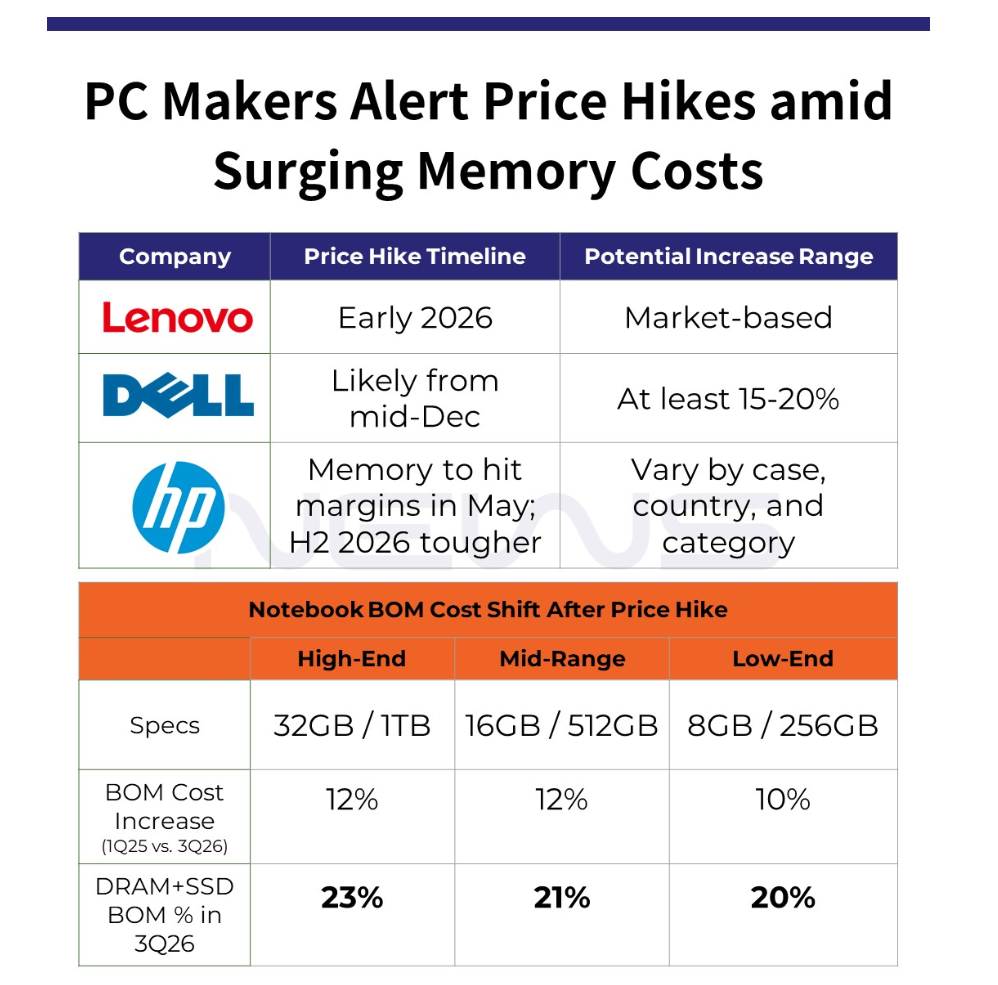
According to a report by TrendForce, which monitors Taiwan’s supply chain, both Dell and Lenovo have sent notices to their own customers warning them that prices will be going up. TrendForce reports that Dell is planning to raise its prices almost immediately: by 15 to 20 percent in mid-December. So far, Lenovo isn’t notifying customers of how much it plans to raise prices, but reportedly will do so in January.
The narrative continues to be a simple one: Venture-backed AI hyperscalers continue to buy up whatever components they can to build out data centers. While Intel and other CPU companies divide up their product lines between the consumer and enterprise markets, the line is much blurrier where DRAM and storage are concerned. With AI companies buying up as much high-speed RAM and SSD storage as they can, that has pulled supply away from the consumer market and caused prices of both components to start rising, quickly.
Prebuilt PC maker CyberPower was scheduled to raise prices on Sunday night, citing increased component costs as well, and it wouldn’t be surprising if other PC vendors did the same.
The problem has rippled up and down the supply chain, with reports that DRAM makers aren’t even providing short-term or “spot” pricing, but asking customers to sign long-term contracts. That, in turn, has left other vendors who have signed such contracts worried about if they’ll be able to source the necessary memory.
TrendForce
TrendForce also predicts that the shortages will pull down PC configurations as well, with “high end” 2026 PCs including just 32GB of RAM and a terabyte of SSD storage, rather than the 64GB of RAM and 2TB of storage that typically populate high-end PCs.
Dell and Lenovo could not be immediately reached for comment.
Author: Mark Hachman, Senior Editor, PCWorld

Mark has written for PCWorld for the last decade, with 30 years of experience covering technology. He has authored over 3,500 articles for PCWorld alone, covering PC microprocessors, peripherals, and Microsoft Windows, among other topics. Mark has written for publications including PC Magazine, Byte, eWEEK, Popular Science and Electronic Buyers’ News, where he shared a Jesse H. Neal Award for breaking news. He recently handed over a collection of several dozen Thunderbolt docks and USB-C hubs because his office simply has no more room.