
THE FITNESS WORLD is so full of acronyms that you might sometimes feel you need to pack a glossary in your gym bag to decode one term from the next. If what you’re looking for is a style of workout that will challenge you to give all-out effort without exercising for hours, however, you only need to understand one four-letter term: HIIT. High Intensity Interval Training allows you to pair hard-hitting exercise periods with short rest breaks for a wide range of health benefits.
You’ll find this style of training everywhere, from boutique fitness studios to big box gyms that offer group classes. Given its popularity and prevalence, with each practitioner aiming to put their own spin on the concept, the public conception of what constitutes a HIIT workout has become blurred.
According to the American College of Sports Medicine, HIIT is defined as a style of training utilizing short, intense work periods performed between 80 and 95 percent of a person’s maximum heart rate. The intensity allows you to burn more calories in a shorter period of time than you would following other protocols. HIIT training can be programmed with all kinds of exercises, making it scalable to different fitness levels and incorporate diverse styles of training (no, it doesn’t have to all be burpees).
HIIT’s popularity stems partly from its efficiency. Unless you’re a professional athlete, you likely don’t have the time to spend two to three hours in the gym. Lack of time is cited as one of the main barriers to fitness, according to the CDC—and HIIT offers a shorter period than other protocols. “A lot of people are super busy, and can’t allot an hour in the gym. [HIIT training] is a good way to get a bang for your buck, and spend less time,” says Jahkeen Washington, C.P.T., owner of JTW Fit and the Harlem Kettlebell Club. You don’t need close to an hour for an effective HIIT session; even 20 to 30 minutes of focused work can be more than enough for the most well-conditioned exercisers.
HIIT sessions are also highly customizable, making them easy to tailor to your personal schedule and preferred training style. From running and strength training to rowing and boxing, there’s a HIIT workout that will work for you. The training protocol is “something that’s scalable is easier for people to utilize,” Washington says.
You might still be a bit confused about what HIIT actually is, and why the workouts are so popular. Here’s what you need to know about HIIT before you go back to the gym for your next session.
What Is HIIT?
HIIT stands for “High Intensity Interval Training” (which makes one of the most popular phrases used to describe it, “HIIT training,” totally redundant). You shouldn’t necessarily think about HIIT as being any one style of exercise, like running or weight lifting. Instead, HIIT is more of a framework, through which trainers can build out different routines depending on the equipment on hand, the experience of the participants, and the amount of time and level of difficulty desired.
One consistent thread through any HIIT program, however, is that workouts are composed of short periods of intense work, then a subsequent period of rest or active recovery. To be most effective, “Intensity” is the most important part of the HIIT equation—participants should be working near or at peak effort during the intervals, then backing off during the breaks. Since this high level of effort can pump up the heart rate, some trainees use HIIT protocols as the cardio component of their exercise routines instead of low intensity steady state training, (LISS) like long runs or cycling.
What’s Most Important for HIIT Workouts

Again, HIIT stands for high-intensity interval training, which refers to the short bursts of intense exercise alternated with low-intensity recovery periods that make up the protocol. HIIT is quick and anything but boring, as its exacting work-to-rest ratios make it arguably the most time-efficient way to exercise and burn calories. You can use the HIIT protocol to build your entire workout, or apply it to just a few sets to create super-charged finishers.
However you do it, what makes HIIT work is the intensity. You’re going hard, typically as hard as you can, for a short period of time, then resting for a length of time that’ll let you recover to go hard once again. Work-to-rest ratio is frequently brought in when discussing HIIT, and there are several accepted ratios you should consider.
- To improve aerobic fitness: intervals would typically involve a work to rest ratio or 1:1 or 1:2 (i.e. work for 30 seconds, rest for 30 seconds).
- To train anaerobically (sport-specific training for power and explosiveness): rest intervals are often longer to allow for a more maximal effort, often at least a 1:5 ratio (i.e. work for 15 seconds, rest for 75 seconds). This is less commonly practiced in group fitness scenarios.
The Key to HIIT Workouts
The key to making HIIT work: The intensity. You can’t coast through your work periods when doing HIIT. The protocol is designed to give you chances to go hard, so you need to take advantage of those chances.
That means working hard, but it doesn’t mean going 100 percent to failure. If you’re completely new to exercise, don’t go truly all out all at once. Instead of 15 to 30-second intervals executed at near-100 percent intensity, intervals of one to three minutes at closer to 80 percent of maximum effort, followed by up to five minutes of lower intensity exercise, have also been shown effective for weight loss in sedentary populations.
In group fitness settings (and among far too many trainers) HIIT and “interval training” are often used interchangeably. Make no mistake: True HIIT requires you to be explosive and intense during your work period. Basic interval training, however, minus the high-intensity aspect, is what you see most on the group fitness scene. Work periods here are typically larger than rest periods, without the consideration for the level of effort expended.
The Primary Benefits of HIIT Workouts

Fat Loss
One review looked at 13 different studies on 424 overweight and obese adults. It found that both HIIT and traditional moderate-intensity exercise can reduce weight and waist circumference.
Metabolic Rate Is Higher for Hours After
Some researchers have found that HIIT increases metabolism for hours after exercise even more than jogging and weight training. This is known as excess post-exercise oxygen consumption (EPOC, informally called afterburn), a measurably increased rate of oxygen intake following strenuous activity.
Overall Health
HIIT is not just a tool to use to lean out. It can improve your overall health, too. A summary of 50 different studies found that HIIT reduces blood sugar levels. Further research shows it can reduce resting heart rate and blood pressure in overweight and obese individuals.
Why You Shouldn’t Do HIIT for Every Workout
This intense workout template is popular enough that it’s become shorthand for just about any type of boutique fitness class that features multiple exercises, different stations, and plenty of sweat. The term is bandied about so much that many people who have taken a HIIT class might not totally understand why they’re pushing so hard through the stop and start nature of the protocol, either.
That doesn’t stop HIIT from being a top choice for boutique gyms and fitness clubs—the workouts fit a ton of activity into a brief period, which is ideal for consumers looking for the most bang for their buck and trainers and gyms hoping to slot as many sessions into a schedule as possible.
That’s fine for gyms with class slots to schedule, but if your whole fitness routine is only made up of HIIT workout sessions, you need to take a step back and reassess what you’re doing. Aiming to add muscle? HIIT can be a great tool to diversify your training, but you won’t be able to make the most gains that way. And if you’re taking on any more than two or three HIIT workouts a week, you’re doing too much. You’ll either push yourself into overtraining if you go as hard as you should be for every session, since you won’t give yourself enough time to recover properly, or (more likely) you’ll fail to reach the effort threshold the workouts are designed around. Be smart about how and when you use HIIT.
Some Ways to Do HIIT Workouts

So, wait, you’re still technically on that dreaded treadmill, right? Not necessarily. Here are some of the different types of equipment and training styles you can use as part of a HIIT protocol.
- Bodyweight workouts
- Strength training exercises (dumbbells, kettlebells, etc)
- Treadmill sprints
- Stationary bike sprints
- Rower sprints
- Ski-Erg sprints
- Boxing rounds
- Battle Ropes
- Sled pushes and pulls
HIIT Workouts to Add to Your Training
Now that you know everything to know about HIIT, here are some HIIT workouts that can keep you off the treadmill (for the most part) and on a far more fun path to major fat-burn.
Bodyweight Beatdown
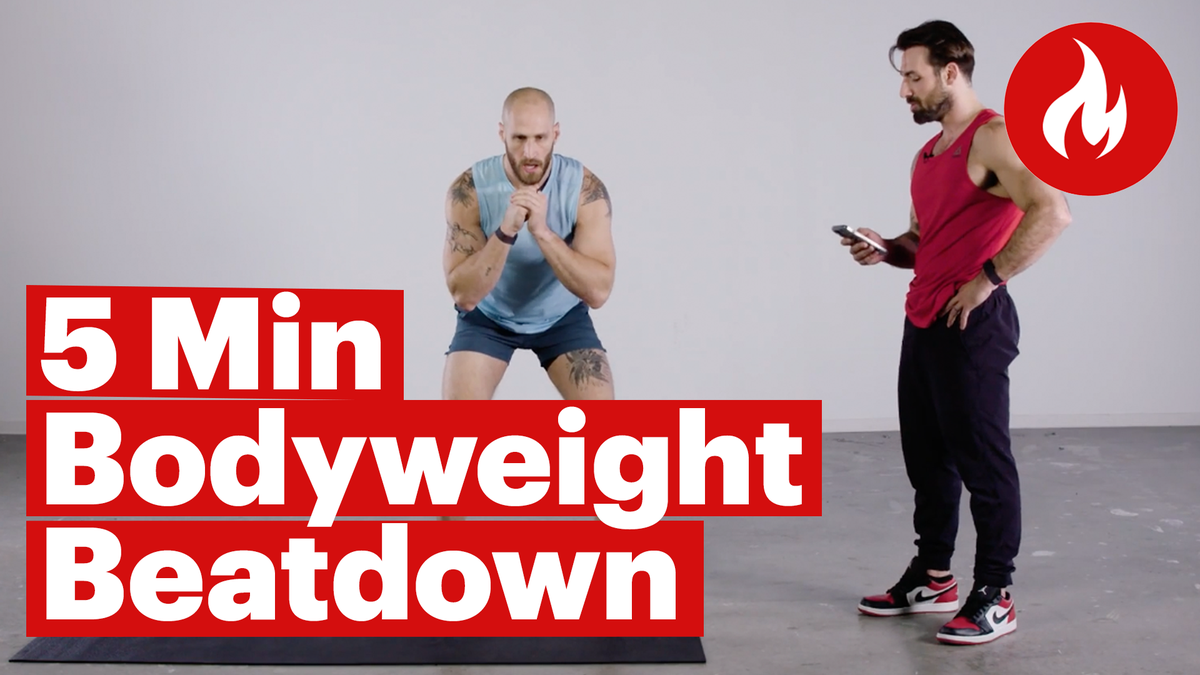
You don’t have access to equipment, and you’re low on time. Luckily, Ben Feiden, CFSC of Performance HQ has just the thing for you. This “quick and nasty” five-minute routine utilizes plenty of plyometrics to get the body and mind moving. All you need is you and a clock to get this full body burn in.
Warmup
10 seconds of work / no rest
- Butt Kicks
- High Knees
- Mountain Climbers
- Plank Up-Downs
Hell Circuit 1+2
Work for 20 seconds / rest for 10 seconds / repeat for 2 rounds
- Air Squats
- Alternating Jump Lunge
- 2-Pushup Burpee
7th Circle of Hell Finisher
Work for 30 seconds / no rest / repeat for 2 rounds.
- Jump Squat
- Lateral Frogger
The 5-Minute Dumbbell Finisher

If you’re really short on time, all you need is 5 minutes to get a hellish workout in. Get ready to get your butt kicked by Jaimar Brown, C.P.T., of J. Malik Fitness in this installment of our 5 Minutes of Hell series. Grab one set of medium and one set of light dumbbells and cycle through the following five exercises for 45 seconds of work, and 15 seconds of rest for a quick and dirty full body workout.
1 set each / 45 seconds of work / 15 seconds of rest
- Romanian Deadlift into Row
- Kneeling Overhead Tricep Presses
- Plank Drags into Pushup
- Lying Skull Crushers
- Dumbbell Marches
The 5-Minute Interval Workout
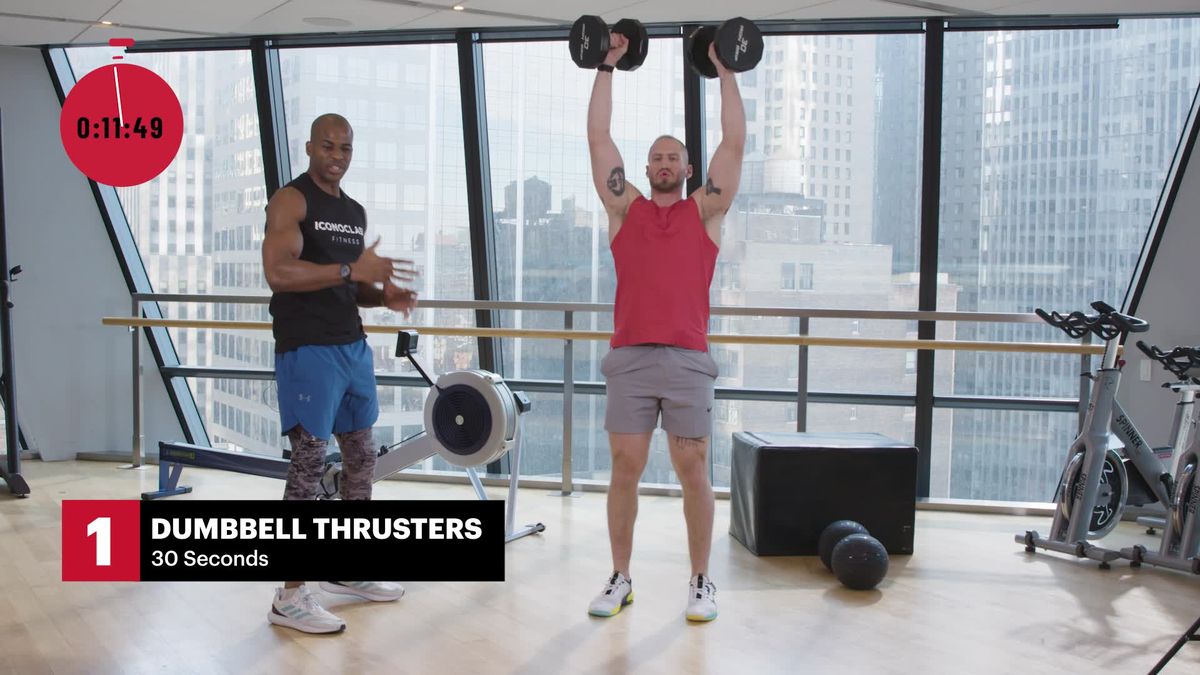
It’s all gas, little breaks for this killer five-minute HIIT workout. Ngo Okafor, the owner and founder of Iconoclast Fitness, and two-time Golden Gloves Championship winner goes through another installment of our 5 Minutes of Hell series designed to push you to your limits in a short amount of time. Complete these eight exercises for 30 seconds of work, 10 seconds of rest for a heart-racing HIIT workout.
1 set each / 30 seconds of work / 10 seconds of rest
- Thrusters
- Box Jumps
- Pushups
- Mountain Climbers
- Dumbbell Bent Over Rows
- Rowing Machine
- Jump Squats
- Ball Slams
The Military-Inspired 5 Minute Burn
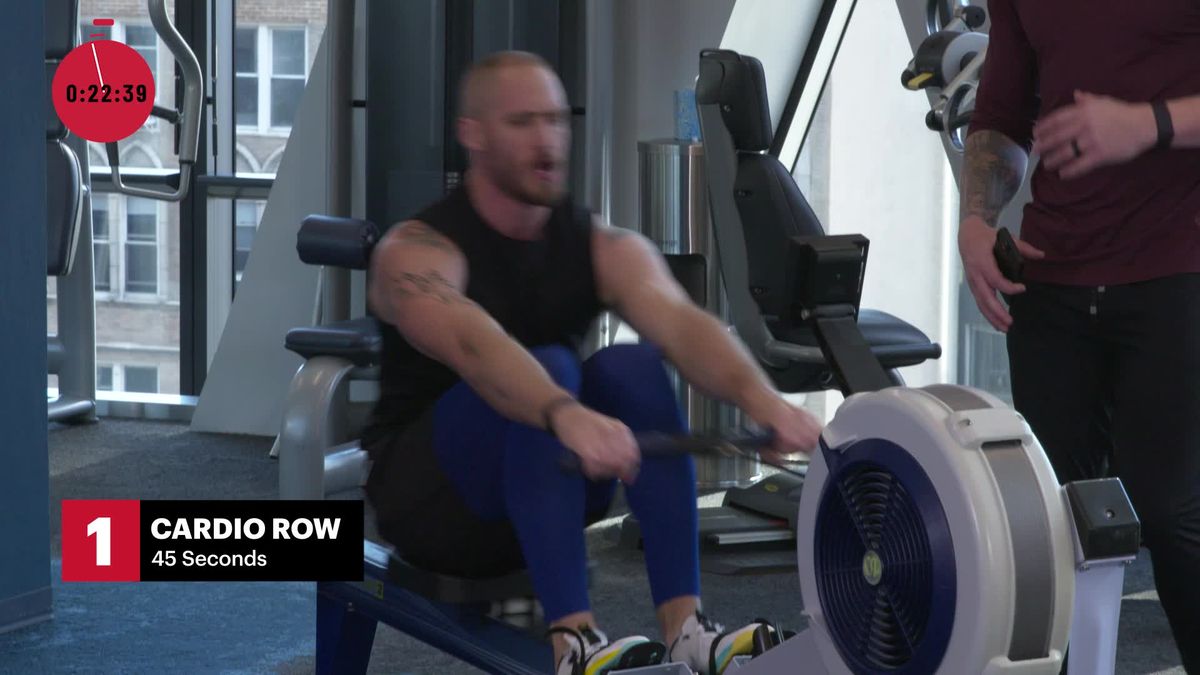
Erik Bartell, C.P.T., founder of Train Like a Soldier, leads through a military-style workout worthy of battle. In only 5 short minutes, this workout will have you contemplating surrender. Work through these 5 exercises for 45 seconds of work, and 15 seconds of rest.
1 set each / 45 seconds of work / 15 seconds of rest
- Rowing Machine
- Kettlebell Alternating Reverse Lunge to Press
- Fast Feet to Reactive Sprawls
- Kettlebell Alternating Reverse Lunge to Press
- Rowing Machine
All Out Studio Upper Body HIIT

This dumbbell workout from All Out Studio’s High Power HIIT program by trainer Gerren Liles will help you to sculpt your chest, arms, and back while ramping up the pace. You’ll be toast after these 15 minutes.
Close-Grip Chest Press – 30 seconds
Close-Grip Chest Press with Crunch – 45 seconds
Close-Grip Chest Press with Crunch and Leg Lowers – 75 seconds
Squat Hold – 45 seconds
Renegade Rows – 30 seconds
Weighted Walkout to Renegade Row – 45 seconds
Weighted Walkout to Renegade Row to Knee Raise and Twist – 75 seconds
Squat Hold – 45 seconds
Dumbbell Over-the-Shoulder Chops – 30 seconds
Squat and Over-the-Shoulder Chops – 45 seconds
Squat Thrust and Over-the-Shoulder Chops – 75 seconds
Cooldown Stretch – 45 seconds
Gerren Liles’ Line and Back Challenge Workout

This session from Liles introduces a challenging wrinkle to the protocol.
You’ll place the four objects out in front of you in a row, spaced about a foot apart from each other and six feet from your own starting position. Assign each object a number, 1 through 4. You’ll begin at the starting position performing an exercise, until Liles calls out a number (or a series of numbers) associated with the objects in front of you. Run up to the row of props, touch the object that he called out, then return to the starting point to begin performing the exercise. If he calls out multiple numbers, return to the starting line after each touch. Each round last for 3 minutes.
Squat Jumps
Pushups with Shoulder Taps
Lunge to Split Jumps
Plank to Hip Dips
Burpee 180° Turn
Bobby Maximus’ Bodyweight Tabata Blast

There are multiple protocols under the HIIT umbrella, the most popular of which might just be Tabata training. The extra-intense format consists of 8 rounds of 20 seconds of all-out work, then 10 seconds of rest. To save you some math, that’s just 4 minutes of work—but the effort makes it worth your while. Here, trainer Bobby Maximus strings together four bodyweight movements for one 16-minute Tabata session: squats, lunges, squat holds, and pushups.
The Basic Sprint Interval
Here’s your ideal HIIT treadmill workout. Warm up with a quick 3-minute jog, then immediately boost the speed so you’re sprinting as fast as you can for 15 to 20 seconds. After that, walk, or jog at a very slow pace for one minute. Then it’s back to sprints.
Repeat this for 10 rounds and you’ll get 15 minutes of good sweat. This works on a treadmill, but it can easily work on a track or football field, too.
The Bodyweight Tabata Circuit
Forget running entirely and get comfortable with bodyweight exercises, again using the dreaded Tabata protocol. Here, you’ll choose a bodyweight move and do it for 20 seconds. Then you’ll rest 10 seconds.
During your 20 seconds of work, make sure to go hard, then rest. Do a maximum of 8 sets.
Yes, that means you’ll be done in exactly four minutes, but that’s half the fun of a tabata. When done correctly, if you’re going hard enough, you’re wiped out after that four minutes, because the electrically fast work intervals are broken up by a mere 10 seconds of rest.
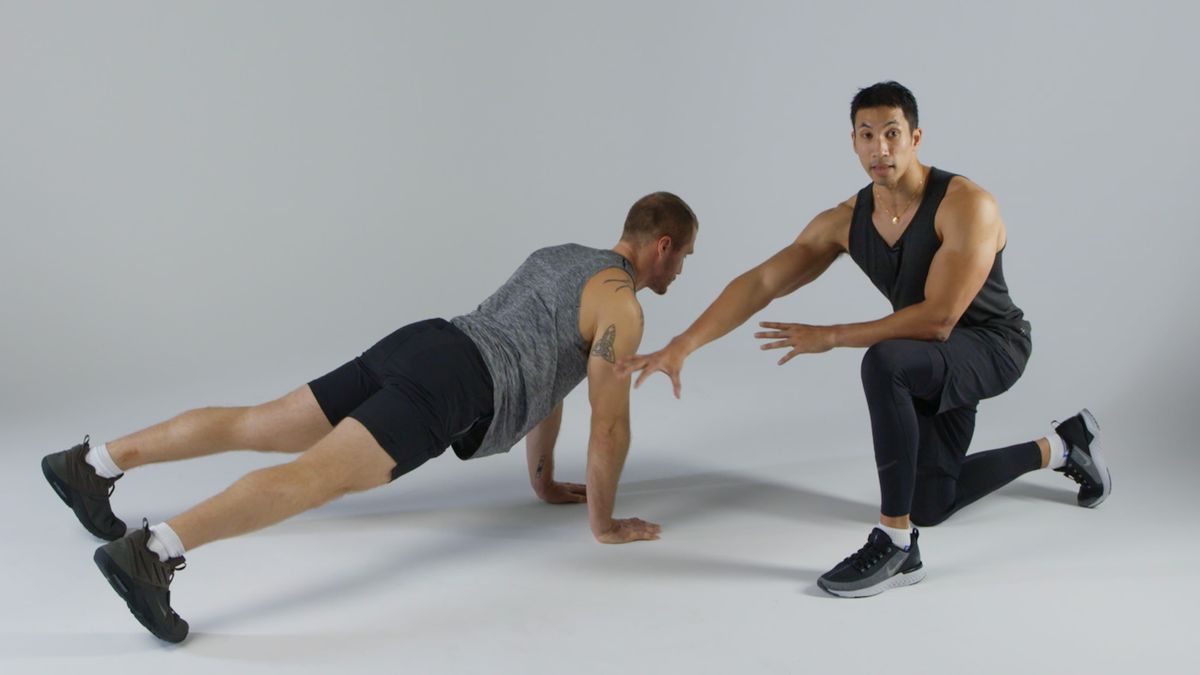
You can do tabata circuits with almost any bodyweight moves you want to use. Try integrating moves like burpees, squats, and mountain climbers. Not sure how to perfectly do a burpee? Check out the video below.
The Bike Sprint
Have a stationary bike? Then blow up your quads and hamstrings with this sneaky HIIT workout. Pedal as hard and fast as you possibly can for 30 seconds, focusing on turning your legs over at a fast pace. Make sure you have some resistance on the bike, too; don’t set it to the lowest resistance.
After that, pedal slowly for one minute at an easy pace. Repeat this for 10 to 20 rounds, depending on how much time you have.
The Battle Ropes Blitz
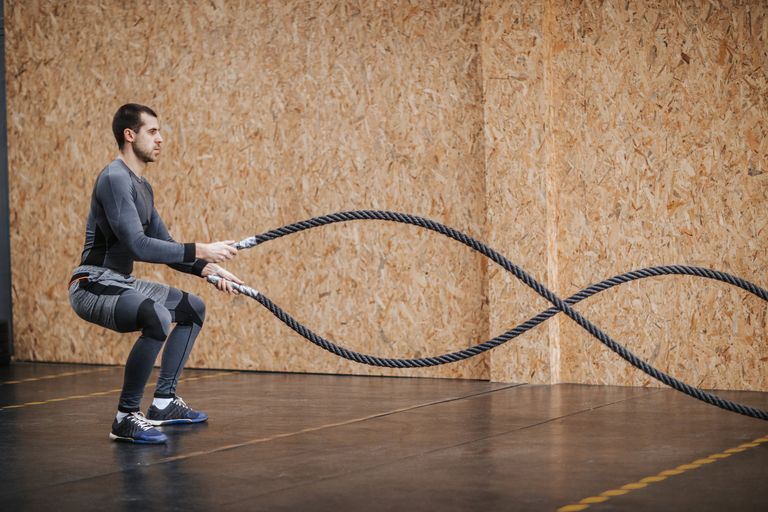
Don’t make it complicated. Just moving battle ropes at a fast and aggressive pace will ramp up your heart rate. So grab a pair of battle ropes and start doing slams or waves; work for 30 seconds. Rest for about a minute. Repeat for 10 rounds.
The Hill Sprint Series
There’s running — and then there are hill sprints. Sprinting on an incline is a brilliant way to train, preventing you from overstriding and also decreasing the impact on your joints. You’ll be far less prone to a hamstring tweak on a hill sprint than you would be on a flat surface.
This one programs itself, too, and doesn’t force you to constantly stare at the clock. Find a hill and sprint up for 20-30 seconds. Then walk back down to your starting point; this serves as your recovery period. Repeat for 10 rounds.
The Sled Push Slam

The sled helps you improve your anaerobic conditioning, letting you battle through sprints that are over quickly. Those sprints are also super-intense, though, because you’re pushing a heavy sled, driving harder than you might if you were just running with bodyweight.
To do this sled push workout, load 70 to 85 percent of your max pushing capacity o the sled; you want to make sure you’re working hard. Now push it explosively, as hard and fast as you can, until you can barely move it. If you choose the right weight, this will be over in seconds — but you’ll still feel pretty fatigued. Rest for 3 minutes; repeat for 4 or 5 rounds.
The Total Body Beatdown
Set a timer for 12 minutes, and get ready to rock your whole body. This is another EMOM circuit. So you’ll have one minute to do each move, then you’ll rest until the start of the next minute. The faster you finish your reps, the more time you get to rest. Don’t get sloppy with your technique, though; continue to do good quality reps, even though you do want to move fast.
Minute 1: 15 air squats
Minute 2: 15 burpees
Minute 3: 10 lying Superman holds
Repeat 4 times.
The Triple Threat
Three moves is enough to get you going for your next HIIT workout. Do each of the following exercises for 30 seconds of work, 10 seconds of rest for at least 3 rounds. Those 3 rounds will take 7 minutes— Washington suggests tacking on as many rounds as you can given the time you have available for your workout.
3 to 12 rounds / 1 set each / 30 seconds of work / 10 seconds of rest
- Dumbbell Thrusters
- Kettlebell Swings
- Med Ball Slams
Single-Kettlebell Tabata
All you need is a single kettlebell to get a sweet in with this full-body Tabata-style workout from Washington. Work for 20 seconds and rest for 10. One round is done once you’ve completed all four exercises on both the right and left side. Again, Washington suggests doing as many rounds as you have time for— somewhere between 4 and 12 rounds.
4 – 12 rounds / 1 set each side / 20 seconds of work / 10 seconds of rest
- Single-Arm Row
- Single-Arm Clean
- Single-Arm Thruster
- Single-Arm Swing
12-Minute Ski-Erg Conditioning Workout

You can always utilize your favorite pieces of cardio equipment to get your HIIT training in. If you’re a ski-erg fanatic, try out this conditioning workout from Nellie Barnett, CPT.
Work for 20 seconds / rest for 10 / repeat for 4 rounds / break 1 minute in between rounds
- All Out Ski
- Arms-Only Ski
- Woodchop Ski
20-Minute At-Home Full-Body Workout
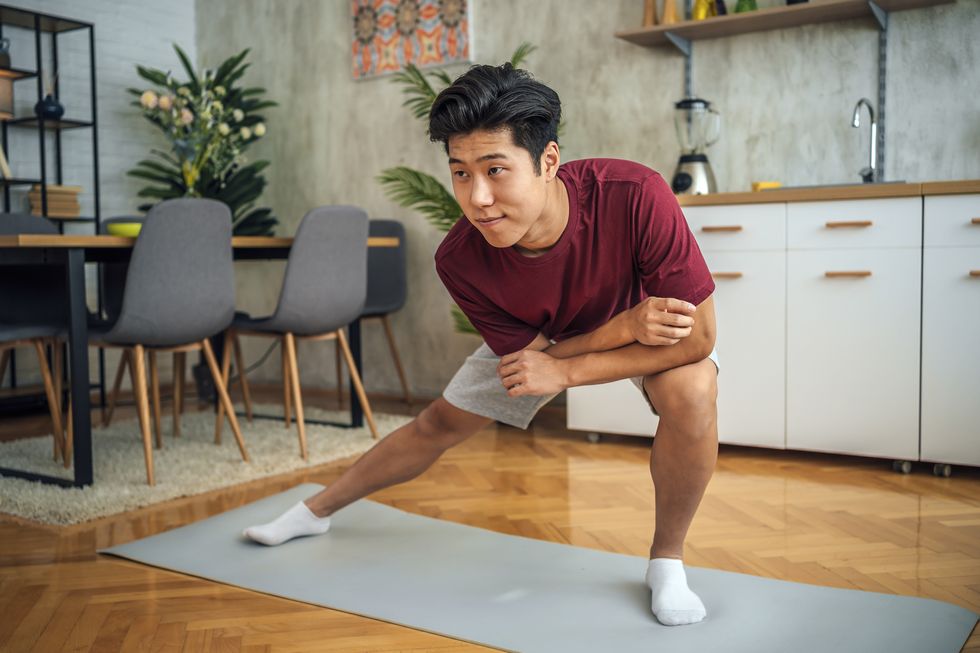
Excuses be damned—you don’t need equipment, or hardly any space, for this burner. Barnett packed everything you need in this quick 20-minute workout you can do right from your living room.
Work for 40 seconds / rest for 20 seconds / repeat each block twice
Block A:
- Side lunge and knee crunch
- Mountain climbers
- Crunch and reach
Block B:
- Hip switch
- Hand release pushups
- V-ups
Block C:
- Toe taps
- Up and overs
- Donkey kicks
12-Minute Kettlebell Lower Body
If you’re looking to target the lower body, and only have a kettlebell—look no further. This workout from Barnett will get your glutes, hamstrings, and quads shaking.
Work for 30 seconds / rest for 10 seconds / 3 rounds / 1 minute rest between rounds
- Kettlebell Side Lunges
- Kettlebell Goblet Squat
- Kettlebell Swings
- Kettlebell Figure 8s
12-Minute Full-Body Dumbbell HIIT Workout

Get a little bit of everything in this full-body workout form Barnett. All you need is a set of medium-weight dumbbells.
Work for 30 seconds / rest for 10 seconds / 4 rounds / 1 minute rest between rounds
- Seesaw Row
- Dumbbell Push Press
- Alternating Dumbbell Snatches
- Single-Arm Thrusters (alternate sides per round)
Dumbbell Compound Movement HIIT Workout
Minimal doesn’t mean inefficient. For an effective full body workout, all you need is a few pieces of equipment. One of the staples is the dumbbell—and this full body workout from David Pegram, C.P.T., Obė Fitness instructor, focuses on compound movements that will torch you with only one tool.
Work for 40 seconds / rest for 20 seconds / 4 rounds / no break between rounds
- Thrusters
- Renegade Rows
- Dumbbell Floor Press
- Alternating Dumbbell Snatches
- Gorilla Rows
Bodyweight Cardio and Core
Having access to equipment doesn’t inherently mean better workouts. This bodyweight only cardio and core circuit from Pegram will get your heart pumping and your abs scorching—no equipment needed.
Work for 30 seconds / rest for 15 seconds / 4 rounds / 30 second break between rounds
- Burpees
- Low Plank Jacks
- Jump Lunge with pulse
- Close-Grip Pushups
- Mountain Climbers
- Plank Walkouts
Rower Cardio Crusher

The gym is busy, but you don’t have the time to be waiting around for every machine. Pegram’s got you. Grab a set of dumbbells and find an open rower. Stay there for the next twenty minutes for this cardio burner.
Work for 20 seconds / rest for 10 seconds / 4 rounds / 30 second break between rounds
- Row
- Dumbbell Goblet Squats
- Row
- Dumbbell Burpee
- Plank Hip Dips
Lower Body Tabata-Style Finisher
With only 20-second working periods, this workout from Pegram will have you panting. Add it to the end of a leg day to get your cardio in while finishing off the lower body. You’ll need just a single dumbbell and kettlebell.
Work for 20 seconds / rest for 10 seconds / 4 rounds / rest for 1 minute between rounds
- Jump Squats
- Skaters
- Dumbell Goblet Squat with an Isometric Hold
- Fast Feet
- Kettlebell Swings
- High Knees
- Jump Lunges
- Lateral Shuffles
Mitch Calvert, CPT
Mitch Calvert, CPT, is a body transformation coach for men, having helped more than 350 guys transform across the globe. He discovered his spark for fitness when he tipped the scales at 260 pounds 14 years ago – and now works specifically with men like his former self who have weight to lose and confidence to gain. Get Mitch’s 2-page “” to simplify your diet and drop stubborn fat.
Cori Ritchey, NASM-CPT is an Associate Health & Fitness Editor at Men’s Health and a certified personal trainer and group fitness instructor. You can find more of her work in HealthCentral, Livestrong, Self, and others.