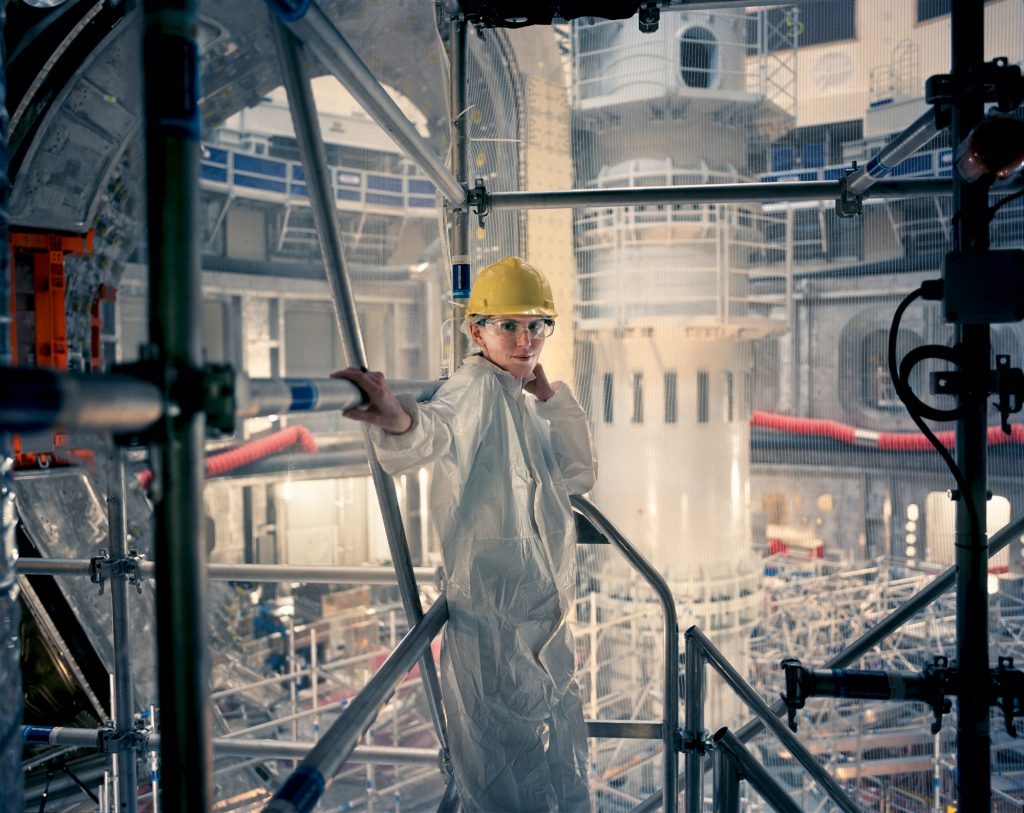

It’s a question one might expect to hear in a course on plasma physics—or at least the physics pop quiz of this word person’s nightmares. But no, we’re in Hearst’s sunny New York design studio, settling in to discuss the spring-summer collection from Chloé, where she has held the role of creative director since 2020. Outside the glass door of her office, her team darts between mood boards and clothing racks and models draped in slinky black garments. Inside, wearing a navy silk shirt and a tweed baseball cap under which she has tucked her blond hair, Hearst is still and focused. She is making fusion fashion, a concept that has occupied her design mind for the last year.
“Fusion is the main source of energy in the universe,” Hearst says, referring to the process of stellar nucleosynthesis, by which protons fuse at the core of all stars, emitting heat and light. “We wouldn’t be here if it wasn’t for fusion, because we are made out of dead stars.” One could say the same of her spring-summer collection, which was inspired by site visits to labs in the Pacific Northwest, New England, and the South of France, where hundreds of scientists and engineers are working to develop technology that will produce a net energy gain through fusion—an as yet unattained goal. Hearst and others refer to them as star-builders. Nuclear fusion, unlike fission, doesn’t produce long-term waste, lacks the potential for meltdown, and has the capacity to produce a lifetime’s worth of energy from the hydrogen atoms in a single glass of water—something of a climate crisis silver bullet. The Chloé models were clad in appropriately physics-inflected designs: Hearst sent a board of eight fuchsia fabric swatches to one company so that their team could color-match the pinky-purple shade of a fusion reaction; hydrogen isotopes, deuterium and tritium, appear as abstract patterns across the clothes. They walked a runway designed to resemble a tokamak, the doughnut-shaped device that produces energy through the magnetic fusion of atoms. The Mexico-based light artist Paolo Montiel-Coppa created enormous incandescent rings, representing magnets, which floated above the stage.
Other designers have attempted to render poetic the ravages of climate change. This spring, Demna Gvasalia sent his models into a human-made blizzard. Following the designation of the monarch butterfly as an endangered species this summer, Collina Strada’s September show took place in a preserve amid fields of milkweed. And fashion has publicly struggled with the problems the industry itself creates. A 2020 report by the nonprofit environmental agency Stand.earth found that the global fashion industry is responsible for more greenhouse-gas emissions than both aviation and the shipping sector. Despite customer-facing public commitments by brands and CEOs—LVMH, Kering, Hermès—“the largest pieces of the fashion supply chain remain dependent on coal for both electricity generation and heat used in apparel manufacturing.” Bleaching, dyeing, weaving. Finishing garments. Transportation. And so the biggest question of all, Hearst believes, is one that faces not just fashion but all industries in a global system that derives 80 percent of its power from fossil fuels: “Where are we getting our energy?”
It is the twofold way in which Hearst attempts to grapple with this question that sets her apart: in aesthetics and through action. Her collections broadcast the themes, while Hearst simultaneously enforces transparency and innovation on production levels—her mission is woven into the very fibers of her clothes.
In her early 20s, Hearst developed a trick to alleviate her anxiety: “I created this thing called my wish list. Whenever I feel anxiety, I write the opposite of what I feel.” The opposite of Hearst’s largest anxiety, climate disaster, she realized last year, is climate success. “I started repeating it to myself like a mantra,” she says. “Climate success. Climate success. Climate success. Climate success.”
Hearst, who was born in Uruguay in 1976 and raised on her father’s 17,000-acre Paysandú cattle ranch, Santa Isabel, grew up with an entrenched understanding of conservation and ethical consumption. After her father’s death in 2011, Hearst, the eldest of four, inherited her childhood home and its surrounding ranchland. It wasn’t until her husband, John Augustine Chilton Hearst, called Austin, pointed out her unique background that she realized what she took for granted about her upbringing might play into her fashion career. “He was the first person to say to me, ‘You need to talk about how you grew up,’ ” Hearst says. “ ‘You need to use the wool of your farm in your clothing.’ ” For this year’s Gabriela Hearst spring runway show, she produced a broadsheet with images of a recent family visit: Hearst and one of her daughters riding in the back of a truck, a herd of cattle in the sunlight. In her office, the designer taps her finger on a photograph of her mother, a Buddhist and fourth-generation rancher, amid a tangle of trees. “This is where I was conceived,” she says. “In her forest.”
For all her engagement with hard science, Hearst identifies as a spiritual person. Her family didn’t want to baptize her, “but I asked to be baptized. I believe in Jesus in the way I believe in Buddha, in the way I believe in all deities. I think spirituality is part of the human condition,” she says. “I know a lot of things exist that I don’t see.” It’s possible Hearst’s role at Chloé—a label launched in Paris in 1952 by Gabrielle Aghion, a Jewish Communist sympathizer who hired Karl Lagerfeld to succeed her—was a self-fulfilling prophecy. Hearst’s first luxury purchase, she says, was a Chloé Edith bag; later, she had a dream that she was helming the brand. In 2020, she submitted a 92-page brief on her proposed direction for the brand. “The main driver,” she says, “besides my love for Chloé, was to see if the seven years that we have had at Gabriela Hearst—as research and development on environmental practices—could be upscaled to a brand that was 70 years old. And how fast can that deployment be?” Faster than expected, it turned out. Last fall, under the direction of Hearst and CEO Riccardo Bellini, Chloé became the first luxury fashion house B Corp, a designation given to corporations that meet criteria pertaining to transparency and “high standards of social and environmental performance.” Chloé currently scores an 85.2 —80 is the bar for certification, and the median score for typical businesses is 50.9.